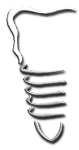
Dental implants are made of biocompatible, neutral titanium. The surrounding bone integrates it (osseointegration) and it becomes part of the bone.
This does not mean that an implant can never be rejected. But the reason is not biological incompatibility, as with transplanted soft tissue. Rejection is caused rather by other factors – early or inappropriate excessive loading, some general illnesses and others.
When an implant counts as failing
An implant is considered to be failing if it is mobile, or if it shows bone loss of more than 1 mm in the first year after placement and more than 0.2 mm in the following year.
The risk of failure is higher in smokers and in people with poor oral hygiene – factors that lead to inflammation around the implant (peri-implantitis), which breaks the bond between the implant and the bone.