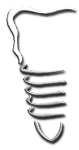
After teeth are removed, the alveolar bone changes its anatomy. These changes are strictly individual and matter a great deal when the treatment plan is made. For a lasting result of implant treatment we need enough bone. If it is there, things are simple and clear.
Augmentation
If there is not enough bone tissue, the bone must first be built up to a level that meets the criteria for an implant with a good prognosis. This process is called augmentation. Extra bone or a bone substitute (sometimes both together) is placed where it is needed, and the jawbone starts to restructure itself there.
Guided bone or tissue regeneration
Augmentation of bone defects combined with various membranes for guided bone or tissue regeneration (GBR – Guided Bone Regeneration, GTR – Guided Tissue Regeneration) has an important place in modern dentistry. It can be:
- one-stage – at the same time as the implant is placed (for smaller bone defects);
- two-stage – first the volume of the jawbone is increased, and the implant is placed in a second stage.
Manual expansion
Another solution for too little bone (an alveolar bone that is too thin) is manual expansion. It uses a special bone expander set of different thicknesses. The aim is:
- to improve the density of the bone, and with it the primary stability of the implant;
- to let the surgeon work more safely, reduce the risk of fracturing the bone and avoid the maxillary sinus;
- most importantly: no further bone is lost, and there is enough room for the implant.
These are supporting surgical methods that aim at a lasting and stable implant treatment.
When there is too little bone around the upper back teeth: Sinus lift.